
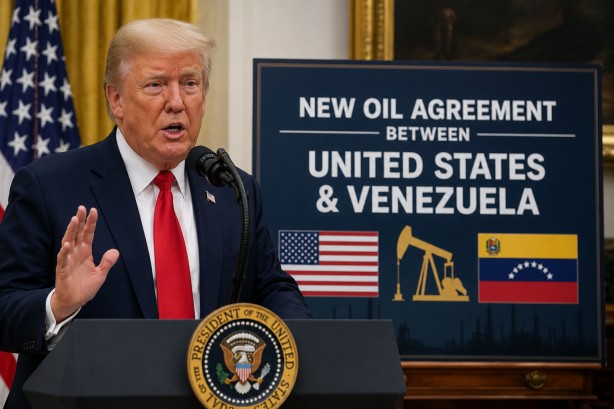
In a significant development, U.S. President Donald Trump has unveiled a new oil agreement with Venezuela, asserting that the United States will secure “majority” control over more than 65 billion barrels of proven Venezuelan oil reserves. Trump highlighted that this agreement was forged through collaboration with private businesses and involved high-ranking American officials. While he hailed the deal as mutually beneficial for both American and Venezuelan citizens, he refrained from disclosing specifics about the companies involved, the oil fields in question, or the framework for U.S. control over these reserves.
Venezuela is known to possess the world’s largest proven oil reserves, estimated at approximately 303 billion barrels. Despite enduring years of decline in its energy sector, the country continues to produce around 1.25 million barrels of crude oil daily. This new agreement aligns with Washington’s objective to enhance the flow of Venezuelan crude to U.S. refineries and to attract American investments into Venezuela’s oil industry. By gaining greater access to Venezuelan oil, the U.S. aims to address escalating gasoline prices and bolster its strategic petroleum reserves.
Reports surfaced earlier this week suggesting that the U.S. was engaged in advanced discussions about acquiring direct stakes in several significant Venezuelan oil fields. These prospective investments are anticipated to involve billions of dollars from American energy companies, underscoring the scale and potential impact of this agreement.
However, the deal has stirred apprehension among segments of Venezuela’s opposition. Critics have raised concerns about the extent of U.S. involvement in the country’s energy resources, questioning the implications for Venezuela’s sovereignty and control over its own oil reserves.
As U.S. energy firms gear up for potential investments in Venezuela’s oil fields, more detailed information about the agreement, including its ownership structure and the participating companies, is expected to be disclosed. The unfolding situation will be closely monitored as it holds significant implications for both nations’ energy strategies and economic interests.